
Documentation
Requirements
Everything CorePanel expects before and during installation. Read this once and the install itself takes about five minutes.
1. The panel server
CorePanel runs on its own machine, next to your hypervisors. A small VM is plenty to start.
| Operating system | Fresh Debian 13 (the installer supports nothing else, on purpose) |
|---|---|
| Resources | 2 vCPU, 2 GB RAM, 10 GB disk recommended minimum |
| Access | Root shell on a machine dedicated to the panel |
| Domain | A domain or subdomain (e.g. panel.yourbrand.com) with its A record pointed at the server before you install: the TLS certificate is issued during installation |
| Reachability | Ports 80 and 443 reachable from the internet; outbound internet for packages and certificates |
The installer asks two questions, your panel domain and the admin e-mail address, and handles the rest: packages (nginx, MariaDB, Redis, PHP, Node.js from stock Debian), database, TLS with automatic renewal, services, and the admin account. The admin password is shown once at the end and stored nowhere.
The install command is personal: create an account, start the free 14-day trial or order a licence, and copy the one-command install from your dashboard. The command carries a short-lived token that activates your licence automatically.
2. Proxmox VE
| Version | Proxmox VE 8 or 9 (validated on 9.2) |
|---|---|
| Certificates | Self-signed is fine: CorePanel pins each node's certificate fingerprint at onboarding, so you do not need valid public certificates on your nodes |
| Exposure | Nodes do not need to be publicly reachable. The panel needs to reach port 8006 on them; nothing else does, consoles included |
| Kernel module | br_netfilter must be loaded on every node. Without it, the IP anti-hijack firewall silently enforces nothing |
Some setups already have it loaded, so check first, on each node:
$ lsmod | grep br_netfilterIf that prints a line containing br_netfilter, the module
is already loaded and you can skip this step. If it prints nothing at
all, run these two commands: the first loads the module right now, the
second makes it load automatically on every reboot:
$ modprobe br_netfilter
$ echo br_netfilter >> /etc/modules
3. The API token
CorePanel talks to your cluster through one API token, created at Datacenter → Permissions → API Tokens. Tokens, users and permissions in Proxmox are cluster-wide, so this is a datacenter-level credential, not a per-node one.
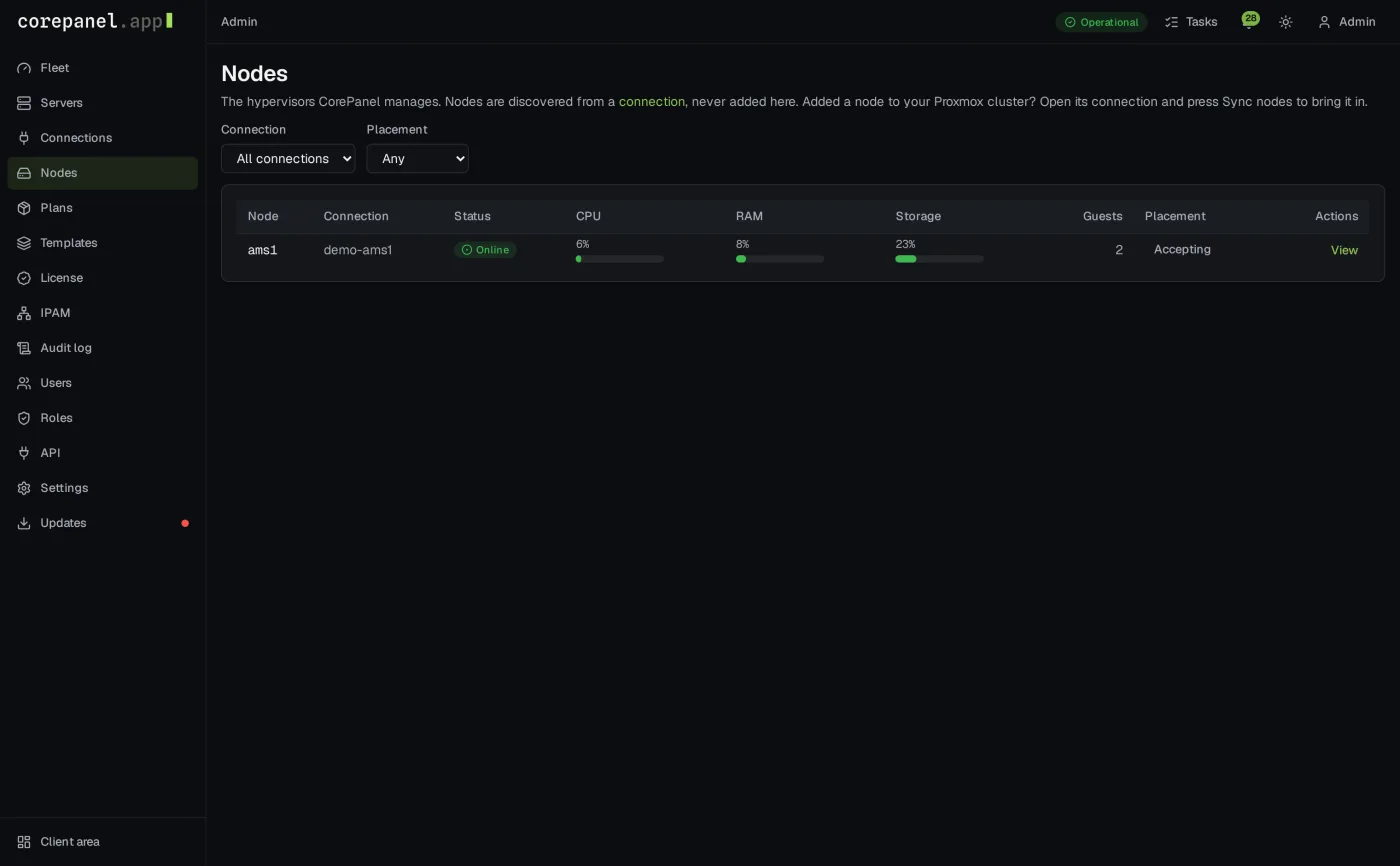
That has a convenient consequence: you onboard a connection, not a node. In CorePanel a connection is one cluster (or one standalone host); give the panel a single reachable host address and it classifies the topology, then discovers and onboards every member node automatically, pinning each node's certificate individually. This is why the admin Nodes page has no "add" button, nodes only ever come from a connection.
Added a node to Proxmox later? Open the connection in CorePanel (Admin → Connections) and press Sync nodes. CorePanel re-probes the connection, pins the new node's fingerprint and starts polling it. Nothing is discovered silently in the background, this one action is the sync.
Creating the token:
- Create a dedicated user, e.g.
corepanel@pve(or useroot@pam). - Datacenter → Permissions → API Tokens → Add: user as above, token id e.g.
panel. If you enable Privilege Separation, grant the token itself the role below; if you disable it, the token inherits the user's permissions. - Grant the Administrator role on path
/with propagation. CorePanel provisions VMs, manages firewalls and storage content, and creates its own restricted console service account, which requires user-management rights. - Copy the secret immediately; Proxmox shows it once.
If the token cannot create users, onboarding still completes and records a console login gap: everything works except browser consoles, until you widen the token and re-probe.
4. Proxmox Backup Server
PBS is optional (local backup storage works out of the box) but recommended. Two ways to connect it:
- Detect from Proxmox (recommended): if your nodes already have the PBS datastore configured as a storage, CorePanel discovers and adopts it. Credentials stay on the Proxmox side; the panel stores only a reference.
- Register in the panel: enter the PBS host, datastore, token and fingerprint, and CorePanel configures the storage on your nodes for you.
Creating a PBS token, on the PBS side:
- Create a backup user, e.g.
backup@pbs, then Configuration → Access Control → API Token → Add, e.g.backup@pbs!corepanel. - Grant DatastoreBackup on
/datastore/<your-store>to the token (Permissions tab, with propagation). - Copy the fingerprint from the PBS dashboard; the registration form asks for it.
Sharing a datastore with another system? Use a PBS namespace. Backup groups are keyed by VM ID, so two systems writing the same datastore will collide on reused IDs ("backup owner check failed"). Create a namespace for CorePanel on the datastore and point the storage at it: full isolation, while deduplication still spans the whole datastore.
5. Templates & guests
| Images | Cloud-init capable images (Debian, Ubuntu, AlmaLinux, Rocky, Fedora cloud images). CorePanel drives users, passwords, SSH keys, IPs and DNS through cloud-init |
|---|---|
| Guest agent | qemu-guest-agent installed in the image. The agent powers IP updates inside running guests, timezone setup, live verification and hijack detection. Official cloud images ship it or install it on first boot |
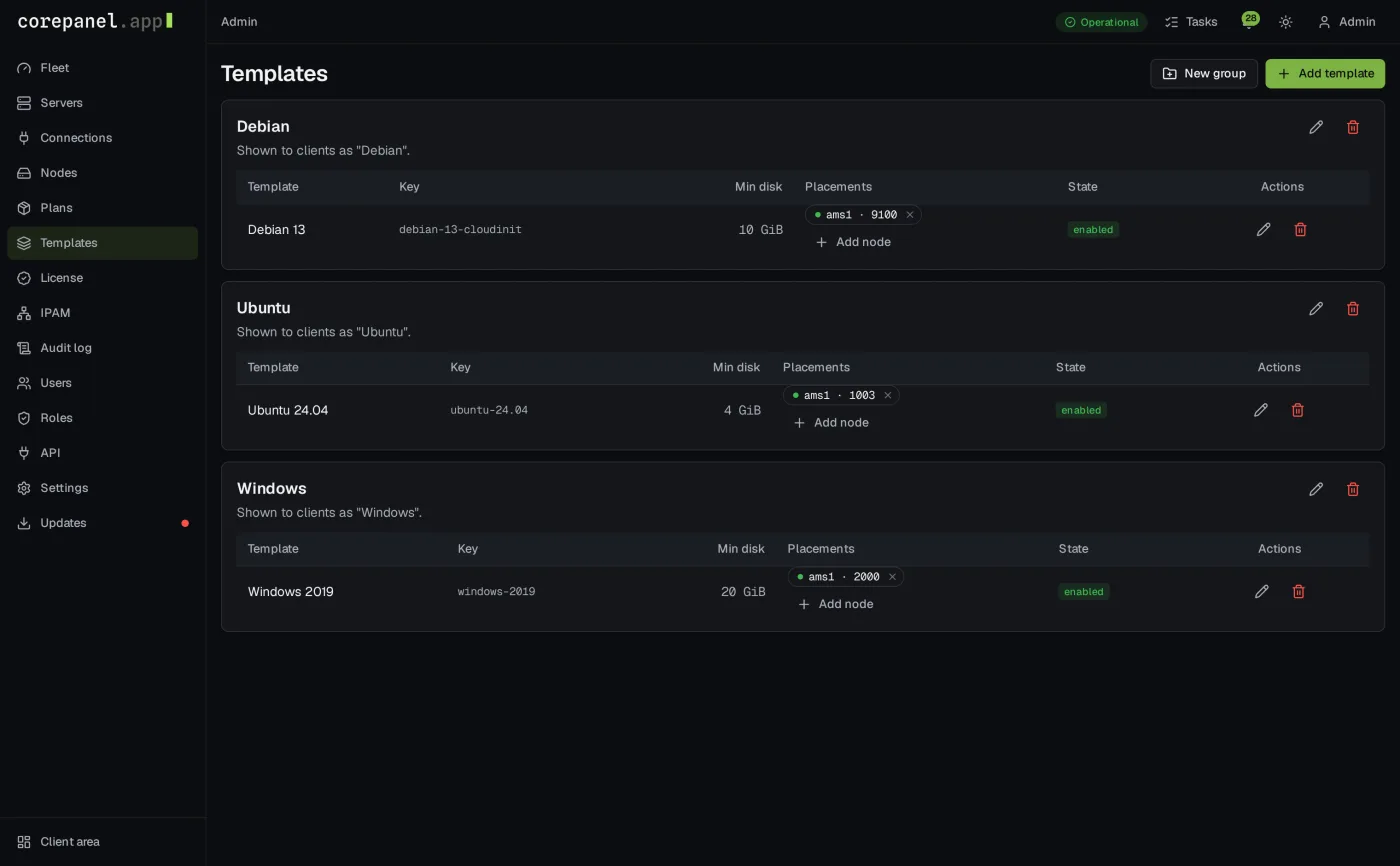
| Placement | Provisioning clones templates node-locally: a template must be present on a node for guests to be built there. The panel tracks template placement per node and syncs it continuously |
6. Networking
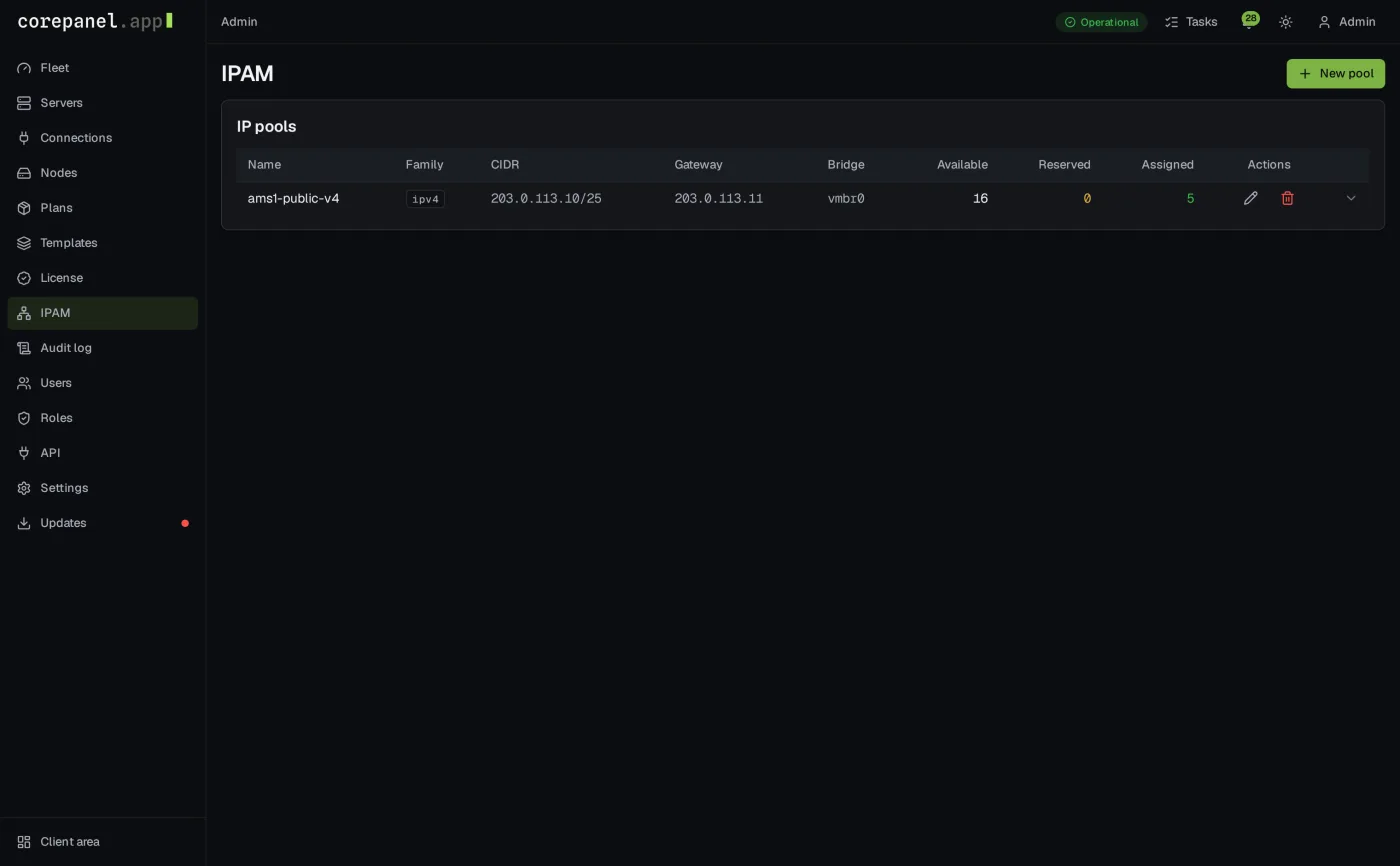
| Guest IPs | Public IPv4 addresses (single IPs or subnets) routed to your nodes' bridge, defined as pools in CorePanel's IPAM. Guests get addresses leased, configured and firewall-locked automatically |
|---|---|
| Bridge | vmbr0 by default; each IP pool can target its own bridge and VLAN |
| Resolvers | Optional per-pool primary/secondary DNS pushed into guests; without them, sensible defaults apply |
7. Billing integration
Billing is optional and pluggable: CorePanel exposes a public API with scoped keys and signed webhooks, and any billing platform or storefront can drive the full service lifecycle through it (create, suspend, unsuspend, terminate, upgrades). For WHMCS there is a ready-made module, so that route needs no custom work at all.
| WHMCS | WHMCS 8.x with the CorePanel server module, dropped into modules/servers/corepanel, plus the webhook receiver addon |
|---|---|
| Anything else | The same REST API the module uses, with per-key scopes and signed webhooks; point your own storefront or billing at it |
| Credentials | A scoped API key minted in CorePanel (Admin → API), entered once in the WHMCS server configuration. Plans and templates then appear as dropdowns in each product's module settings; nothing is configured by ID |
Every install documents its own API: Admin → API in your panel is where you mint and scope keys, configure the signed webhooks, and find the full endpoint reference for whatever you want to build against it.
8. Ports at a glance
| Internet → panel | 80, 443 (customers, staff, consoles, websockets: everything rides the panel domain) |
|---|---|
| Panel → nodes | 8006 (Proxmox API; consoles are relayed server-side over the same path) |
| Nodes → PBS | 8007 (backup traffic) |
| Internet → nodes | Nothing required. Keep them private |